
Google Still Owns “Plumber Near Me.”
AI Owns “Why Is My AC Blowing Warm Air?”
Here’s What That Does to Your Leads.
At 2:17 on a hot Tuesday, somebody in your service area typed “why is my AC blowing warm air” into ChatGPT instead of Google. They got an answer, a short list, and maybe a next step before your CSR ever picked up the phone or your van ever left the lot. That is a digital marketing strategy problem, not an “AI is the future” problem, because it changes where your leads start and why the phone can go quiet even when your ad spend did not move.
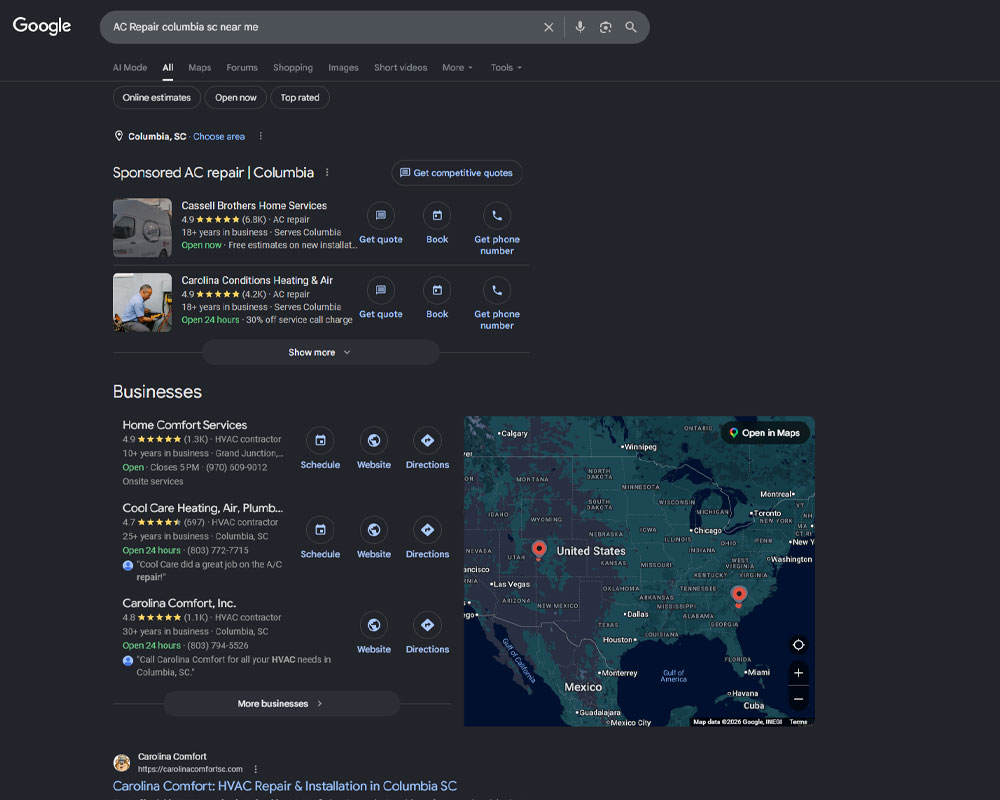
Google still owns “AC repair near me.” LSA, ads, GBP, and the local pack still carry the money queries. But the diagnostic question right before that – the question that tells a homeowner whether this is DIY, a price-shopping exercise, or a real service call – is getting answered in AI more often than most shops realize.
That matters in Charlotte, Greenville, and every smaller market where you used to assume the lead started on Google. Here is what changed in one year, what AI actually uses to pick you, what advice to ignore, and what this means for phones ringing, booked jobs, and booked revenue.

The shift happened fast
BrightLocal’s 2026 Local Consumer Review Survey found 45 out of 100 consumers used AI tools for local business recommendations in the past 12 months. A year earlier, it was 6 out of 100. AI went from a rounding error to a real discovery channel in one year.
BrightLocal also found that AI is now the No. 3 discovery channel behind Google and Facebook, ahead of Yelp and TripAdvisor, and ChatGPT was the top AI tool in that survey for local recommendations. The part you should care about most is who is using it: 64 out of 100 adults ages 30 to 44 have already asked AI for a local recommendation. That is not kids fooling around with a chatbot. That is the homeowner with a mortgage, two kids, and a broken system on a Wednesday afternoon.
The same BrightLocal survey showed Google review usage dropped from 83 out of 100 consumers to 71 out of 100 in a year. People still check reviews. BrightLocal says 97 out of 100 AI users sometimes double-check AI recommendations against real reviews. But AI is now shaping the first shortlist before they ever get to your site or your CSR.
Google still owns “near me.” AI is eating the diagnosis.
This is not “Google is dead.” SparkToro and Datos put Google at more than 5 trillion searches in 2024. When somebody types “plumber near me” or “emergency electrician near me,” Google still runs the board.
The shift is in the earlier question. Ahrefs found only about 8 out of 100 local searches trigger an AI Overview, versus roughly 21 out of 100 keywords across its broader baseline set, but basically every keyword in that AIO set was informational. Put plainly, “water heater repair near me” is still mostly a classic Google fight. “Why is my water heater leaking?” is where Google and AI start answering before the click.
Whitespark’s local AIO case study makes the split even clearer. Across its broader local business set, AI Overviews showed up in 68 out of 100 queries. But only 15 out of 100 simple local-intent searches triggered one. Informational queries triggered AIOs 92 times out of 100, and hybrid queries like “average cost to replace an AC unit in Charlotte” triggered them 97 times out of 100.
Different studies use different keyword sets. The direction is the same. Transactional “call somebody now” searches are partly insulated. Diagnostic and research queries are not. That is the layer where a three-bid homeowner starts researching before your phone ever rings.
AI is a whitelist, not a ranked list
SOCi’s 2026 Local Visibility Index looked at more than 350,000 locations and found ChatGPT recommended only 1.2 out of every 100 locations in that universe. Google’s local 3-pack surfaced brands from that same universe in roughly 36 out of every 100 searches. Do the math, and AI is about 30 times more selective.
That is the real change. Google has room for the messy middle. A decent shop with a solid GBP, enough reviews, and a live ad budget can still show up. AI behaves more like a whitelist. You are either on the short list or you are not. There is no comfortable position 7 where you still get scraps.
SOCi also found that only about 45 out of 100 of the brands winning in traditional local search overlapped with the brands winning in AI. Half the old winners are losing the new format. And ChatGPT was only 68 out of 100 correct on business info in SOCi’s test, versus 100 out of 100 for Gemini. So yes, AI can still get details wrong. People are still using it anyway.
What AI actually uses to pick you
First, other sites have to talk about you. Ahrefs’ study of 75,000 brands found that branded mentions on authoritative third-party sites had a 0.67 correlation with AI Overview visibility, stronger than backlinks. Whitespark’s 2026 Local Search Ranking Factors put presence on expert-curated “Best Of” lists at the top of AI visibility factors. That boring local publisher list or supplier spotlight can matter more here than another chest-thumping home page paragraph.
Second, your site still matters, but not by itself. BrightLocal’s study of 800 local searches in ChatGPT Search found business websites made up 58 out of 100 local-search sources, third-party mentions made up 27 out of 100, and directories made up 15 out of 100. Three Best Rated was the single most common directory source in that set. Then Yext’s analysis of 6.8 million AI citations found 86 out of 100 citations came from brand-controlled sources, with ChatGPT leaning heavily on listings and directories while Gemini leaned more on websites. The takeaway is simple: your site matters, your listings matter, and other people saying your name matters.
Third, reviews still separate a real shop from the Chuck in a Truck and the tail-light warranty roofer. SOCi found AI-recommended businesses averaged roughly 4.1 to 4.3 stars, while brands sitting around 3.4 stars with fewer than 5 out of 100 reviews answered were effectively invisible. BrightLocal also found people still fact-check AI recommendations against real reviews. AI is not replacing reputation. It is filtering with it.
Fourth, AI likes pages that answer fast and read like answers, not essays. In Kevin Indig’s analysis of 1.2 million ChatGPT citations, 44 out of 100 citations came from the first third of a page, and 78 out of 100 citations that contained a question came from headings. His follow-up study on 815,000 query-page pairs found that focused pages beat giant “ultimate guide” pages, and pages that open with a direct statement beat hedged copy. Put plain: lead with the answer, use a question heading, and back it up with real nouns, numbers, brands, parts, and places.
Fifth, page-one Google rankings are not the whole game anymore. Ahrefs found that only 12 out of 100 AI-cited URLs rank in Google’s top 10 for the original prompt, and about 80 out of 100 do not rank in Google’s top 100 at all. So when somebody tells you AI visibility is just “do more SEO,” that is too small. This is part SEO, part reputation, part distribution.
And now there is a straight distribution play in the middle of it. On October 6, 2025, Thumbtack announced its native partnership with OpenAI, which lets ChatGPT surface Thumbtack pros for U.S. home maintenance, repair, and improvement questions. You do not have to love Thumbtack for that to matter. It means being in that marketplace is now part lead-vendor decision, part AI visibility decision.
What does not work, no matter how slick the pitch sounds
Ignore the posts promising some magic schema bump in ChatGPT. Search Engine Land’s review of the evidence said there are no peer-reviewed studies or controlled experiments proving schema markup lifts AI search visibility. Schema is still worth having for Google and Bing hygiene. It is not a proven lever for ChatGPT, Claude, or Perplexity citations.
Same story with llms.txt. It is a proposal. It is not a live lever. John Mueller said publicly that no AI system currently uses it. So do not burn a Saturday afternoon on llms.txt while your reviews sit unanswered and your diagnostic pages say nothing useful.
The part you feel in the ad account
This is not a theory. It is lead math. LocaliQ’s 2025 home services benchmarks put the average home-services CPL at $90.92, up $8.64 year over year from roughly $82.28. Then the trade-specific numbers got ugly: roofing at $228.15, plumbing at $129.02, and HVAC at $127.74.
The longer arc is worse. LocaliQ’s historical numbers show average home-services CPC went from $4.07 in 2021 to $7.85 in 2025. You are paying almost twice as much just to get the click. Then your tech still has to run the call and figure out whether it was a real job or just a price shopper.
HVAC shows the pain plainly. In Searchlight Digital’s 2026 HVAC benchmark set, branded search costs $34 per lead. Non-branded search costs $149 per lead, and at a 37.6-out-of-100 book rate, that worked out to $804 to land one customer. That is why losing the free diagnostic click hurts. You usually buy it back at a worse price.
LSA is still usually the cheapest bought lead left on the table. The Media Captain’s August 2025 benchmark pull put HVAC at $80 per lead, plumbing at $69, and roofing at $162. It is agency data, not Google data, so treat it as directional. The direction is clear enough: if the phone is quiet and you have to replace organic demand with paid demand, LSA is often cheaper than standard search.
Now, stack that against what Google is doing on informational searches. Ahrefs found AI Overviews cut position-one click-through by roughly one-third in its 2025 study, and its 2026 update put the drop at 58 out of 100. Pew Research’s study of 68,879 searches showed the same pattern in plain numbers: when an AI summary showed up, 8 out of 100 searches ended in a click. Without one, 15 out of 100 did.
LocaliQ says rising competition and ad inventory are driving the paid side, not AI. Fair enough. Both things can be true at the same time. You can be paying more for the click while Google and ChatGPT make that click harder to earn.

What actually moves the needle
First, own the diagnostic layer. “Why is my AC blowing warm air?” “Why does my breaker keep tripping?” “Why is there water under my water heater?” Those are not junk topics anymore. Ahrefs and Whitespark both show that informational and hybrid queries are where AI answers show up hardest, and Whitespark’s ranking factor survey also puts dedicated pages for each service near the top of AI visibility factors. If you do not answer those questions cleanly, you do not make the shortlist when the homeowner starts there.
Second, make your review profile look alive. Ask for the review. Answer the review. Keep the star rating north of mediocre. SOCi tied AI visibility to review quality and response rate, and BrightLocal showed AI users still go check the real reviews before they call. That means reviews still help both the machine and the human.
Third, get named in the places AI already trusts. Whitespark says expert-curated Best Of lists matter. BrightLocal found directories still show up in local AI answers. Ahrefs found brand mentions matter more than backlinks. Local news, associations, chambers, supplier spotlights, award lists, neighborhood guides, and industry directories all do more for you here than another page stuffed with town names.
Fourth, make sure the site is server-rendered, or at least readable in raw HTML without JavaScript. Vercel’s crawler data says the major AI crawlers fetch pages but do not execute JavaScript. Googlebot renders. GPTBot, ClaudeBot, PerplexityBot, and AppleBot do not. If the words that matter load only after the browser does a bunch of work, Google may see them, and AI crawlers may miss them.
Fifth, be deliberate about marketplaces. After Thumbtack’s ChatGPT integration, being on Thumbtack stopped being just a lead-buying decision. It became a distribution decision. That does not mean dump your whole budget there. It means stop pretending those platforms live in a separate bucket from search.
What this means when the phone is quiet
The big shift is not that Google disappeared. It did not. The big shift is that your next booked job can start in two different places now. The emergency “near me” search still runs through Google. The diagnostic question that comes before it increasingly runs through AI. If you win only the second step, you show up late. If you lose both, you buy the lead back.
That is why the old playbook feels thinner. More spending. More cloned pages. More reports. None of that fixes the fact that AI recommendations are built from reviews, third-party mentions, answer-first pages, and the platforms wired directly into the assistant. This is strategy work in the real sense of the word: knowing where the lead starts, what makes you visible there, and what it costs when you are not.
Schedule a free marketing audit. You will get a straight answer on why the phone is quiet, where AI is cutting into your lead flow, what your site and reviews are telling these platforms, and what to fix first. No black box. No pretty report that hides the problem. Just the stuff that affects phones, ringing, booked jobs, and booked revenue.